Let’s head together to northern Bohemia to visit the Jablonec-based company DEVINN. It is here, in the picturesque foothills of the Jizera Mountains, that one of the most prominent Czech innovators in the field of hydrogen technology was born.
.webp)
You can find a link to the full article published in the trade journal MM Průmyslové spektrum, Issue No. 6, here.
A company that grew out of automotive development for giants such as Škoda Auto is now applying its expertise to the burgeoning world of clean energy. The H2BASE mobile hydrogen generator, manufactured by DEVINN, gives the concept of "clean energy" a tangible and, above all, practical dimension.
The path to groundbreaking innovation usually begins with the courage to challenge the status quo and step outside one’s comfort zone. For DEVINN, a company long recognized as a leading center for the development of headlights and comprehensive automotive electronics—including the construction of functional prototypes—entering the world of hydrogen was an ambitious yet logical step. For Luboš Hajský, the company’s CEO and the driving force behind the entire project, the hydrogen molecule was the answer to the challenges of the energy transition. In Jablonec nad Nisou, they decided not to wait for what the market would bring, but to actively help shape it. The result is H2BASE—a device that in many ways replaces a standard diesel generator, but hides a technological revolution with a zero carbon footprint “under the hood.”
Imagine the following situation: You are standing in the middle of a nature reserve or in a closed exhibition hall and need a stable power source to run sensitive equipment. A conventional diesel generator is unacceptable in such a case—it produces noise, vibrations, and acrid smoke, requiring a complex exhaust system. In such an environment, a hydrogen-powered unit behaves like a silent companion. While diesel engines make their presence known from a distance, the Jablonec “base” is characterized only by the refined hum of its fans and compressor—a sound that ranges from 40 to 60 decibels, depending on the load.
.JPG)
The H2BASE generator has been in active use for several seasons now. It has become an integral part of major festivals such as Rock for People and Colours of Ostrava, where it has powered the backstage areas and stages without any annoying noise or exhaust fumes. (Photo: Jakub Červenka)
“For the layperson, the H2BASE system can best be described as a hydrogen-powered generator that, from the user’s perspective, operates exactly like a standard diesel generator. You simply plug it in and draw power,” explains Karel Souček, Director of Development at DEVINN. “For technical experts, however, this device represents a sophisticated assembly of three basic modules. In its basic configuration, it provides a continuous output of 25 kW, but thanks to its unique internal architecture and high-quality components, it can safely cover power peaks up to 100 kW. The output is standard 230 V or three-phase 400 V, making our generator a universal power source for any standard electrical device.”
DEVINN’s technological edge is no accident. It stems from decades of experience in the automotive sector, where mistakes are not tolerated and the pressure for reliability is extreme. In Jablonec nad Nisou, the company operates its own accredited testing laboratory, where components undergo a “trial by fire” in the form of thermal shocks, humidity, and brutal vibrations. It is precisely this durability—which the company incorporates, for example, into the LED headlights for Tomáš Tomeček’s Dakar rally cars—that has also become the foundation for the H2BASE generator.
The journey from the first sketch to a working prototype took about two years and was fraught with a number of technical challenges.
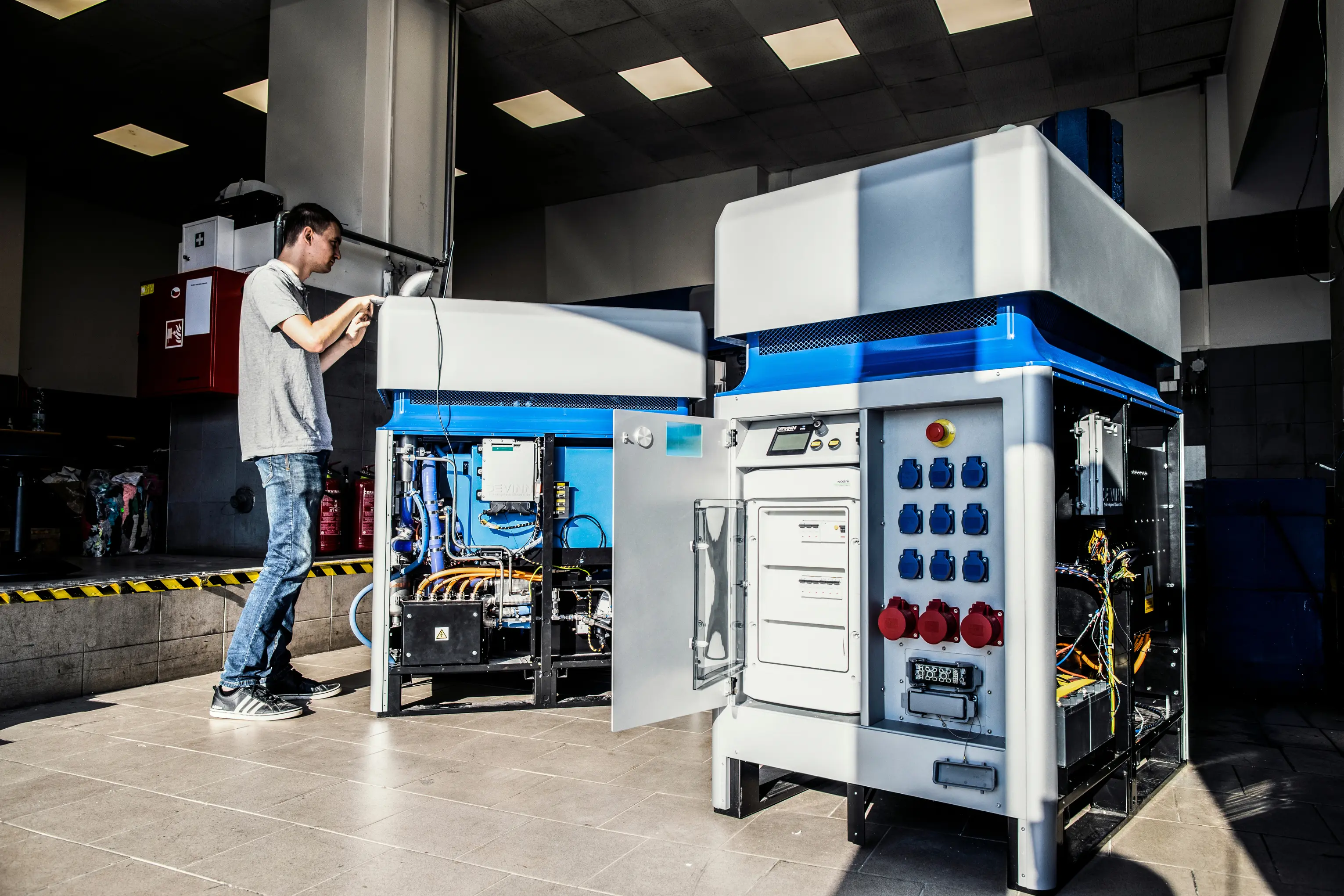
The H2BASE generator operates quietly—it emits only the soft hum of the fans and compressor, a sound that ranges from 40 to 60 decibels.
“The biggest challenge was meeting the requirements of the European ATEX directives. Ensuring absolute safety in potentially explosive zones—which are naturally associated with hydrogen—was our number one challenge,” recalls Karel Souček.
According to him, the second challenge was the availability of components. A few years ago, the market for parts for hydrogen applications was very limited. Finding components that were compact enough for mobile installation while also delivering the required performance required almost detective-like work. This task was undertaken by the team led by Jiří Vršínský, an application engineer and the person behind the final technical design of the entire system.
One of H2BASE’s greatest strengths is its openness. The name (in the feminine form—“the base”) refers to a foundation that provides a secure energy infrastructure, whether you’re at a rock festival or on a construction site in remote terrain. The entire architecture is strictly modular. If a customer finds they need higher continuous power output, they simply add fuel cell modules. If longer operating time is a priority, capacity can be easily increased by adding additional hydrogen tanks.
What’s more, everything is connected to a “digital brain”—DEVINN’s own custom-developed control software.
“We can program the device precisely according to the intended use. It can respond to external stimuli, switch to energy-saving modes, or be integrated into a broader building management system,” adds Jakub Jaček, head of hydrogen technology development, noting: “Remote supervision and real-time monitoring of operational data are standard features, with the option to implement a remote start function.”
The H2BASE generator is not the only product in DEVINN’s portfolio. It is part of a comprehensive chain designed to bring hydrogen into everyday use. This is also confirmed by other products. For example, the H2PORT mobile refueling station uses the same logic of easy handling—hydrogen tanks on pallets can be easily transported and refilled at a standard public station, which radically simplifies logistics.

As a key partner, DEVINN is involved in the development of the Tatra hydrogen truck, for which it is responsible for the integration of fuel cells and comprehensive software control. A hydrogen refueling station is shown on the right.
Perhaps the most fascinating member of the family, however, is H2BOT, a semi-autonomous robotic charger for electric vehicles. Although development was originally focused on full autonomy, the reality of technical obstacles led the team to an innovative control system similar to that of an FPV drone. The robot is controlled remotely via the internet (it is capable of transmitting video) and full autonomy kicks in only in the final phase: the machine locates the vehicle’s charging plug on its own and performs the connection sequence. This concept elegantly solves the problem of charging in large parking lots, i.e., where it is not feasible to build costly fixed infrastructure for every parking space.
The H2BASE system has proven for several seasons now that this is not merely a laboratory experiment. This generator has become an integral part of major festivals, such as Rock for People and Colours of Ostrava, where it powered backstage facilities and stages without any annoying noise or emissions. However, it has also proven its true value and reliability in crisis situations: it served as an emergency power source in 2021 during natural disasters, powering a school and two households during a power outage in Mikulčice, which was hit by a tornado.
“Feedback from organizers of large events is crucial for us. The environmental benefits and quiet operation are viewed very positively, but customers naturally take issue with the high purchase price,” Karel Souček admits candidly.
The development of hydrogen technologies is an extremely costly process. For the H2BASE generator, the company’s own funds accounted for 55% of the costs, with the remainder covered by a grant from the Technology Agency of the Czech Republic. It is encouraging, however, that for more recent projects, the share of grant funding has been reduced to just 10%, which means that hydrogen technologies are already becoming commercially viable in Jablonec.
If we compare a hydrogen generator with a diesel generator, the economic analysis currently still favors fossil fuels. Diesel engines are manufactured in the millions and burn raw materials that are “simply extracted from the ground.” Hydrogen, however, must be produced, which increases the initial costs.
“However, as we transition to green technologies, we must realize that it’s not just about the price per kilowatt-hour. It’s about a mix of energy sources and, above all, energy independence,” Souček emphasizes.
The power of hydrogen lies in its ability to store energy over the long term—something batteries cannot do. At the DEVINN factory in Jablonec, the H2BASE system is now at the heart of a comprehensive energy management system, connecting photovoltaics, an electrolyzer, and storage tanks. It is a working model of the future that, in an era of fluctuations in power grids and the threat of blackouts, offers a path to grid balancing and stability.
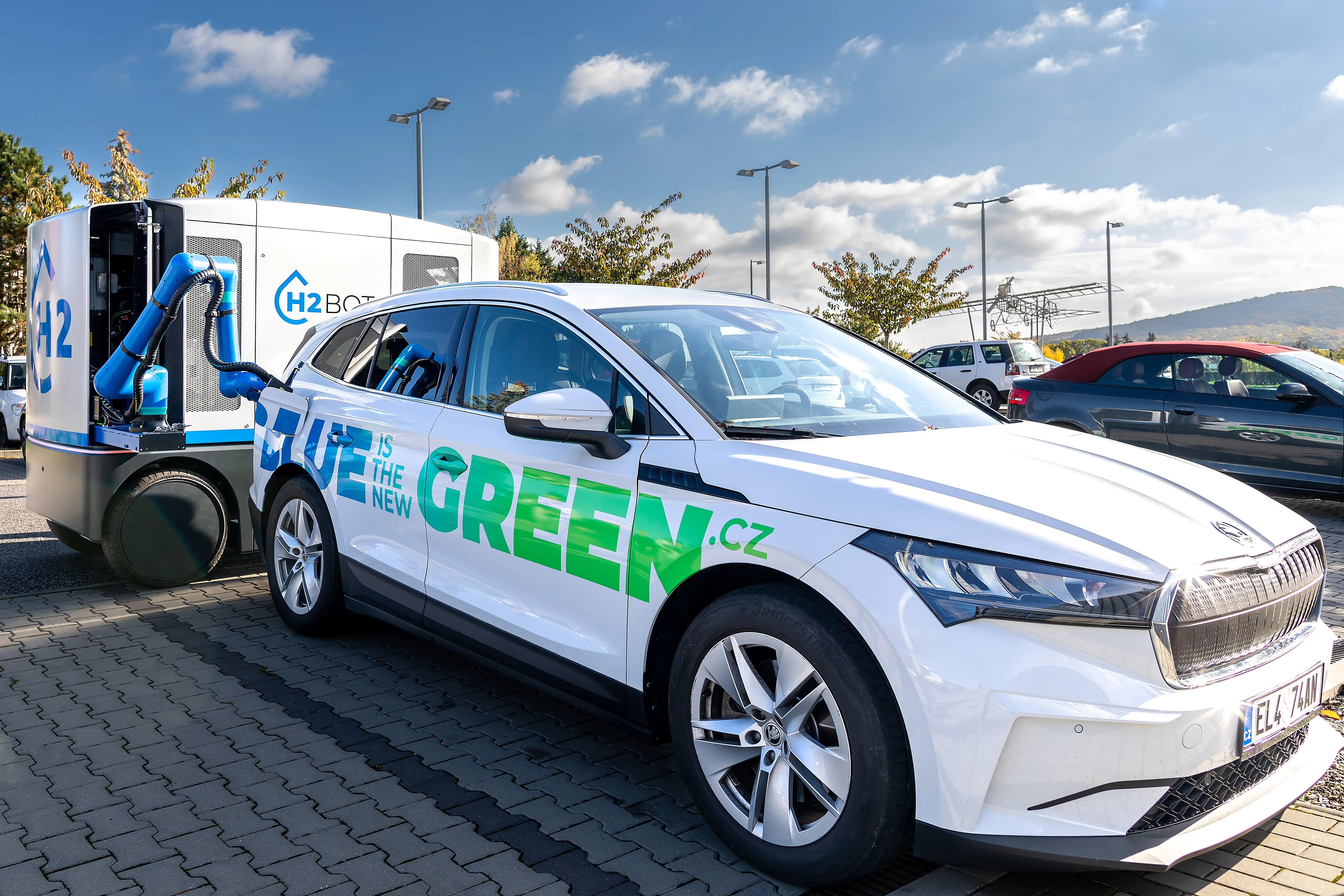
Another member of the family is H2BOT—a semi-autonomous robotic charger for electric vehicles. The robot is controlled remotely via the internet, with full autonomy kicking in only during the final phase, when the machine locates the vehicle’s charging plug and connects to it.
The Jablonec-based company’s ambitions extend beyond the region’s borders. DEVINN is participating as a key partner in the development of the Tatra hydrogen truck, for which it is responsible for fuel cell integration and comprehensive software control. Business negotiations regarding international expansion are also underway, although the company is realistically waiting for a stronger “use case” to emerge that would justify the current price of hydrogen.
DEVINN intends to continue operating primarily as a development center and manufacturer of specialized technologies that do not require massive industrial facilities, but rather a high degree of intellectual expertise. Its story is clear proof that “Czech golden hands” have, in the 21st century, transformed into the ability to master even the most complex processes, such as water splitting. In Jablonec, they are not just building machines, but laying the foundations for a world that will be quieter, cleaner, and significantly less energy-intensive than the current one...▪️
View all


