The July blackout in the Czech Republic confirmed the importance of energy self-sufficiency. Thanks to its own hydrogen economy, our facility in Jablonec nad Nisou remained operational even during the outage. We share technical details and practical experience from the operation of the entire system, which supported us at a critical moment.
Power outages can bring production and normal business operations to a halt in an instant. Whether it's a short-term local problem or a widespread blackout, the consequences are always significant – loss of time, money, and continuity of ongoing projects, including obstacles to work on the part of the employer while maintaining employees' wage entitlements.
That is why at DEVIN we have been working for a long time on solutions that enable energy self-sufficiency or backup and ensure stable operation even when the central grid fails. The H2BASE system and the entire hydrogen economy built at our site in Jablonec nad Nisou play a key role in this strategy.
On July 4, 2025, a large part of the Czech Republic was hit by a widespread power outage. Jablonec nad Nisou was also left without power. While most companies had to interrupt their operations unexpectedly, we were able to continue working thanks to our hydrogen solution.
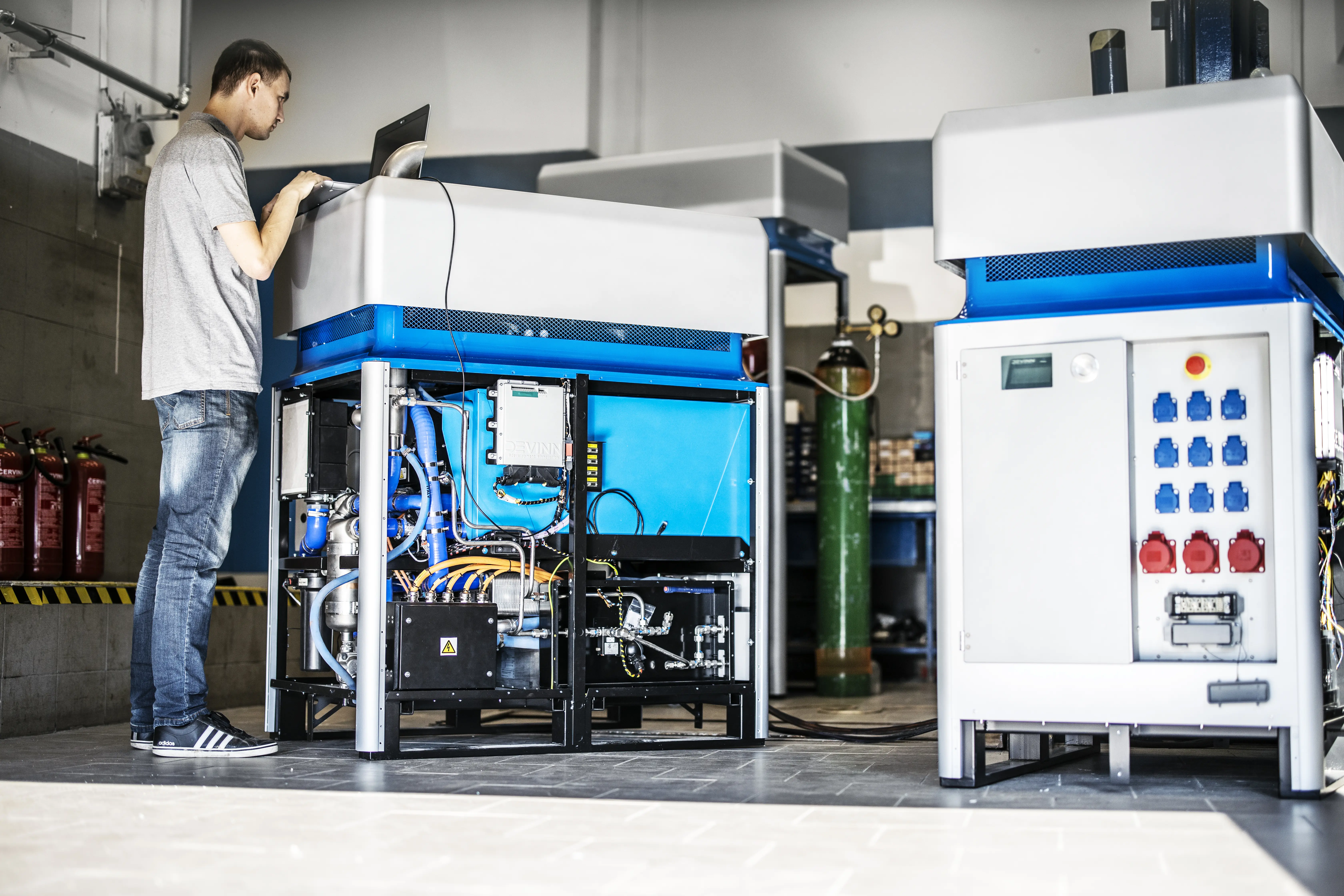
At the moment of the outage, we connected a hydrogen generator to the premises and secured the supply of electricity for key operations. The blackout thus became a real-life test of the functionality of the entire system and confirmed that hydrogen management is not just a theoretical concept, but a practically usable technology.
The company's premises are designed as a multifunctional technological facility that combines several types of operations with different energy requirements:
The total area of the complex exceeds 2,500 m², with office space accounting for approximately 30%, workshop and development areas 60%, and the remainder being technical and logistical facilities.
Energy consumption varies significantly depending on the type of operation and time of day. While the administrative section shows relatively stable consumption during the working day, technological and development operations are characterized by higher peaks and variable consumption depending on specific testing or production cycles.
The annual electricity consumption of the complex is in the order of tens of MWh, with not only the volume of consumption playing a key role, but also the need for energy stability and operational independence.
The hydrogen economy in Jablonec is a pilot project. We have specific technical data available:
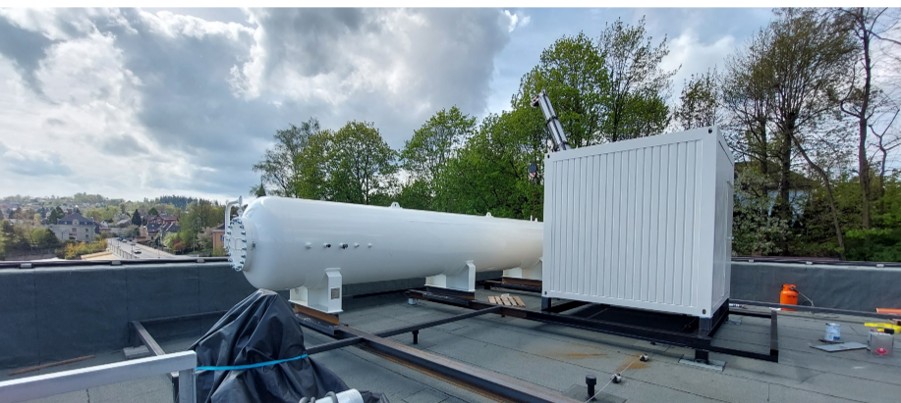
In a specific blackout situation, we used approximately 8 kg of hydrogen stored in a pressure vessel on the roof and in hydrogen bundles, and powered the facility for 6 hours. If we take this event as average consumption, then the total supply of approximately 185 kg of hydrogen would last for 138 hours and 45 minutes, which corresponds to just under 6 days of continuous operation.


The real situation has shown that the hydrogen economy is not a vision of the distant future, but a functional technology of today. The hydrogen supply at the Jablonec site allows the facility to continue operating even during a day-long power outage.
The system is also designed to be modular, so its capacity can be gradually expanded according to the growing needs of the facility or changes in operational load.
The hydrogen economy in Jablonec combines several key elements into a single functional unit:
This combination provides long-term capacity, flexibility, and energy self-sufficiency.
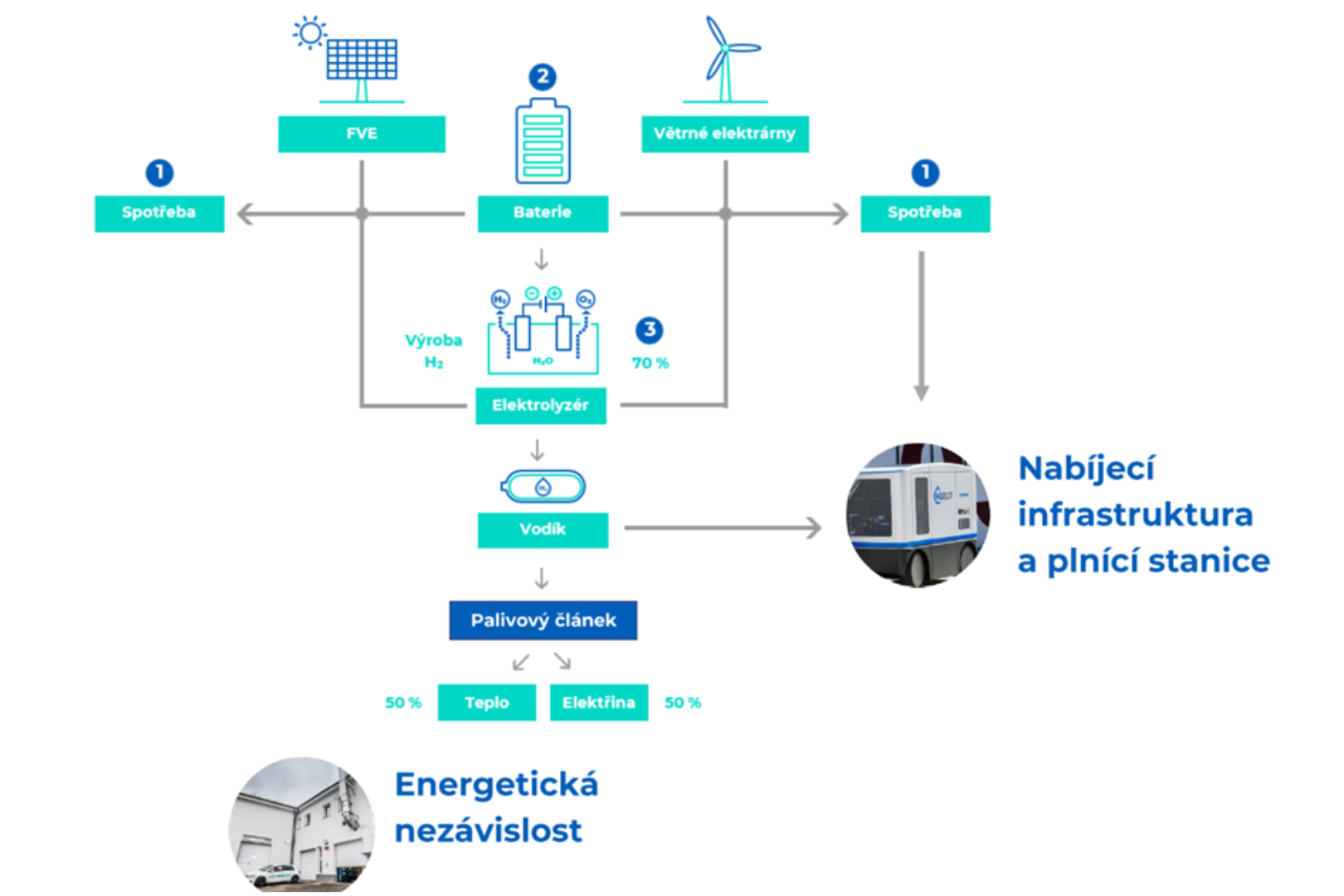
Battery storage handles short-term day-night cycles very well. However, if we want to store large amounts of energy for weeks or months, hydrogen is the logical choice.
The hydrogen economy is therefore not a replacement for batteries, but a strategic complement to them.
Based on our experience, the hydrogen economy has the greatest benefits for:
Each project begins with a feasibility study, based on which we design the performance of the electrolyzer, fuel cell, and storage capacity. The modular solution allows for gradual expansion and planning with a reserve for the future.
The path to a hydrogen economy typically involves four steps:
We look forward to welcoming you and showing you our electrolyzer, storage facility, and H2BASE system in action.
More heads know more, and we believe that the best solutions arise from partnerships. If you are looking for a way to transform your energy sector and gain independence based on real data, let's get together and discuss how we can put your vision into practice together.
View all


